
- Payroll
- Benefits in kind
- P11D
- Class 1A NICs
Mandatory payrolling of benefits: what practices need to do before April 2027
From 6 April 2027, employers must report the most common benefits in kind through payroll instead of on P11Ds, under HMRC's mandatory payrolling rules. That is now less than five months away, and the final pieces of HMRC guidance landed in November 2026.

5 min read
Key takeaways
- When it starts:
- Mandatory payrolling of benefits starts on 6 April 2027 for company cars and car fuel, company vans and van fuel, and medical insurance.
- Phase 2:
- Most other benefits in kind follow from 6 April 2028, while employment-related loans and living accommodation stay on P11D for now.
- No registration needed:
- Payrolling becomes the default for mandated benefits, so employers only register to voluntarily payroll other benefits.
- Class 1A in real time:
- Class 1A NICs on payrolled benefits are paid through payroll in real time, not as a lump sum the July after the tax year ends.
- Globally mobile employees:
- Employers can apply to keep eligible globally mobile employees on P11D and P11D(b), and applications need to be in by 5 April 2027.
- Tax rules unchanged:
- Existing valuation, making good and exemption rules still apply; the change is how and when tax is collected, not how much.
- What practices should do now:
- Map every client that files P11Ds, gather car, fuel and premium data early, and review engagement letters for monthly benefits work.
For practices that run payroll or prepare P11Ds for clients, this is the biggest change to benefits reporting in years. The work moves from a once-a-year form to every pay run. Here is what is changing, what HMRC has confirmed recently, and what to do with your client base before April.
What’s changing
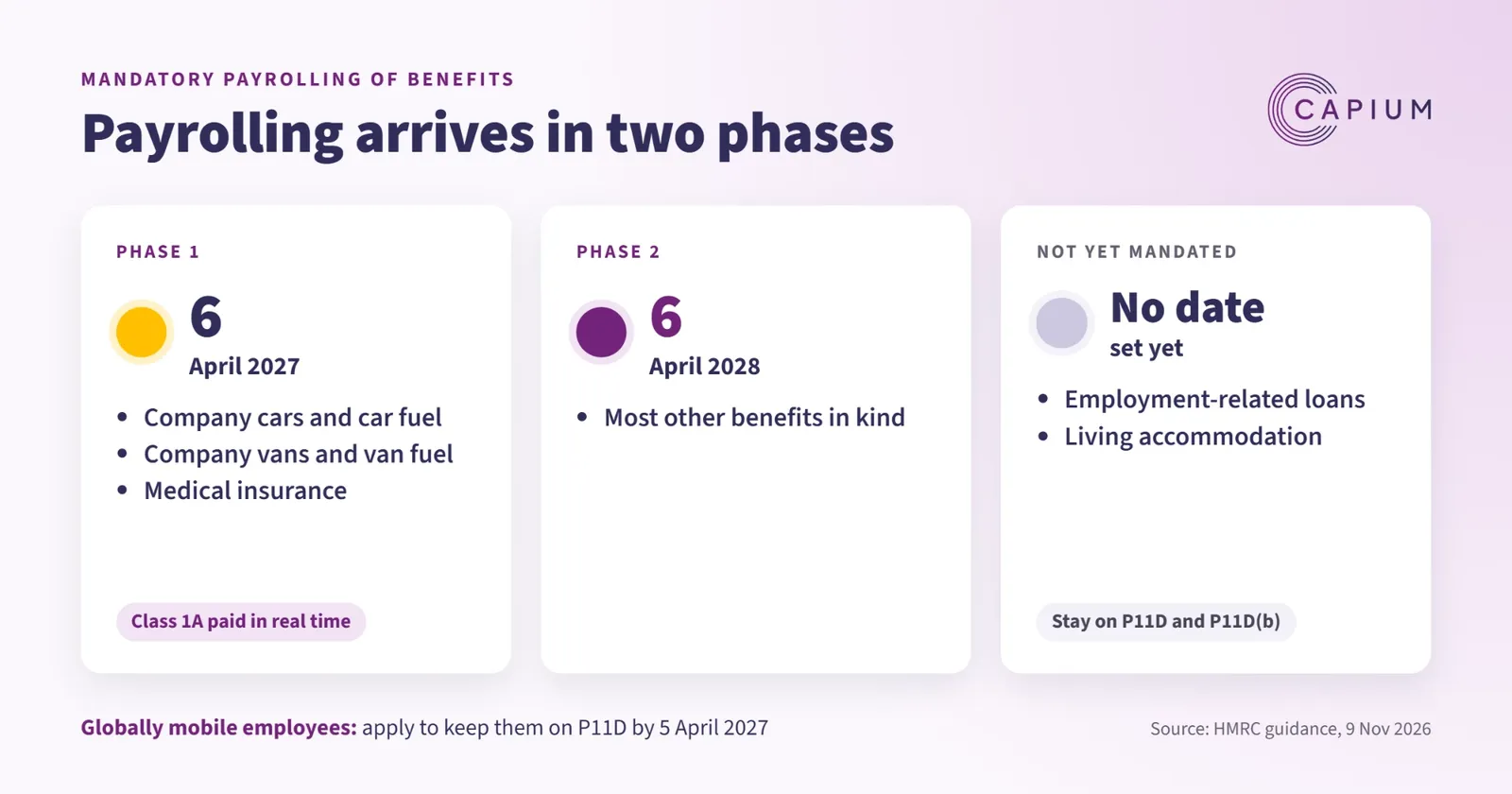
Mandatory payrolling arrives in two phases. Phase 1 covers a short list of benefits; almost everything else follows a year later.
| Phase | From | Benefits covered |
|---|---|---|
| Phase 1 | 6 April 2027 | Company cars and car fuel, company vans and van fuel, medical insurance |
| Phase 2 | 6 April 2028 | Most other benefits in kind |
| Not yet mandated | No date set | Employment-related loans and living accommodation (P11D continues) |
A few points clients often ask about:
- No registration needed for mandated benefits. Payrolling simply becomes the default. Registration is only needed to voluntarily payroll other benefits, and it must be done before the tax year starts.
- No P11D for payrolled benefits. Benefits that are payrolled drop out of P11D and P11D(b) reporting.[1] The forms stay for anything not payrolled.
- The tax rules themselves don’t change. Existing valuation, making good and exemption rules still apply. The change is how and when tax is collected, not how much.
- Tax codes will change. HMRC will remove payrolled benefits from employees’ tax codes, so tax is taken through each pay run instead.
Class 1A NICs and the recent changes
Class 1A NICs on payrolled benefits will be paid in real time through payroll, not as a lump sum the July after the tax year ends.[1] That changes employers’ cash flow, so it’s worth flagging to clients now.
HMRC confirmed two further decisions in September 2026:
- Voluntarily payrolled benefits bring Class 1A with them. From 6 April 2027, if an employer voluntarily payrolls a benefit outside Phase 1, the Class 1A NICs must also go through payroll in real time.[2] The tax can’t be payrolled while the Class 1A is reported at year end.
- Globally mobile employees can be excepted. Employers can choose to keep eligible globally mobile employees on P11D and P11D(b). This is opt-in: HMRC opened an online application in November 2026, and applications need to be in by 5 April 2027.[1] Until an exception takes effect, those employees’ benefits must be payrolled.
One transitional point: for 2026/27, Class 1A on voluntarily payrolled benefits still goes through the P11D(b)[2], with payment due by 6 July 2027.
What practices should do before April
The practices that find April easiest will be the ones who start reviewing clients this side of Christmas. A practical checklist:
- Map your client base. Pull together every client that currently files P11Ds and note which provide cars, vans, fuel or medical insurance. These are your Phase 1 clients.
- Gather benefit data early. You’ll need car list prices, CO2 figures, fuel arrangements and policy premiums before the first pay run of 2027/28, not after year end.
- Check for globally mobile employees. If any client has internationally mobile staff, decide whether to apply for the exception and submit it by 5 April 2027.
- Decide on voluntary payrolling. Consider whether clients should also payroll other benefits now, remembering that Class 1A would then move to real time too.
- Talk to clients about cash flow. Class 1A paid through the year replaces a single July payment.
- Help clients brief employees. Staff should know their tax codes will change, their payslips will look different, they won’t pay more tax overall, and they’ll get an annual payrolled benefits statement.
- Review your engagement letters and fees. Monthly benefits processing is ongoing work, not an annual P11D job. Make sure scope and pricing reflect that.
- Confirm your payroll software is ready. Check it can calculate and report benefits and Class 1A on the Full Payment Submission.
How Capium can support your practice
Preparing for mandatory payrolling of benefits is a good opportunity to review your payroll processes and the software you use to manage them. Capium’s connected cloud accounting suite brings payroll together with bookkeeping, accounts production, tax and practice management, helping accountants streamline workflows and reduce manual administration.
Want to see how Capium could support your practice? Book a demo to explore the software and discover how it could help you manage your clients’ needs more efficiently.
Find out more: www.capium.com · Telephone: 020 3322 5578
This article is general information, not tax advice. HMRC guidance may change; check GOV.UK for the latest position.
Frequently asked questions
When does mandatory payrolling of benefits start?
6 April 2027 for company cars and car fuel, vans and van fuel, and medical insurance. Most other benefits follow from 6 April 2028.
Do employers need to register to payroll mandated benefits?
No. Payrolling becomes the default for mandated benefits. Registration is only needed to voluntarily payroll other benefits before they're mandated.
Will P11Ds disappear completely?
Not yet. Employment-related loans and living accommodation stay on P11D and P11D(b), and so does any benefit that isn't payrolled.
How is Class 1A NICs paid on payrolled benefits?
In real time through payroll, not as a single payment the July after the tax year ends.
Further reading
- Prepare for mandatory payrolling of benefits in kind GOV.UK
HMRC's own guidance on which benefits must be payrolled from April 2027 and what employers need to do.
- Mandatory payrolling of benefits now less than five months away ICAEW
ICAEW's November 2026 round-up of the latest HMRC confirmations.
- Payroll: annual reporting and tasks GOV.UK
Official HMRC overview of end-of-year payroll tasks, including the final FPS, issuing P60s, and reporting expenses and benefits.
- Running payroll: Reporting to HMRC GOV.UK
Explains Real Time Information (RTI) reporting and how payroll submissions are sent to HMRC each pay period.
References
- Prepare for mandatory payrolling of benefits in kind, GOV.UK. Accessed .
- Mandatory Payrolling updates released, CIPP. Accessed .