
- Making Tax Digital
- Self Assessment
- MTD for Income Tax
- Practice advice
Two deadlines, one busy season - how to survive Self Assessment and MTD this January
Every accountant knows January. Late nights, missing records, and a 31 January deadline that never moves.

6 min read
Key takeaways
- Two deadlines in one season:
- The 2025/26 Self Assessment deadline is 31 January 2027, and the next MTD for Income Tax quarterly update is due seven days later, on 7 February.
- Who is in MTD now?
- MTD for Income Tax went live in April 2026 for sole traders and landlords with qualifying income over £50,000.
- The soft landing:
- For 2026/27, HMRC will not issue penalty points for late quarterly updates, but digital records must still be kept and all quarterly updates submitted before the client can file their MTD tax return.
- Penalties from 2027/28:
- From 2027/28, a missed quarterly update or tax return deadline can generate a penalty point for clients already in MTD.
- Other penalties still apply:
- Late tax returns and late payments are not covered by the MTD easement.
- The April 2027 cohort:
- Sole traders and landlords with more than £30,000 of qualifying income in 2025/26 come into scope from 6 April 2027, so this January's returns decide who joins MTD next.
- Two rulebooks from April:
- Clients joining in April 2027 will not receive late filing penalties for their 2027/28 quarterly updates, but existing over-£50,000 clients get no such extension.
- Plan from November:
- Triage clients now, pull Self Assessment work forward to mid-December and chase MTD records before 5 January so 7 February is a batch job, not a scramble.
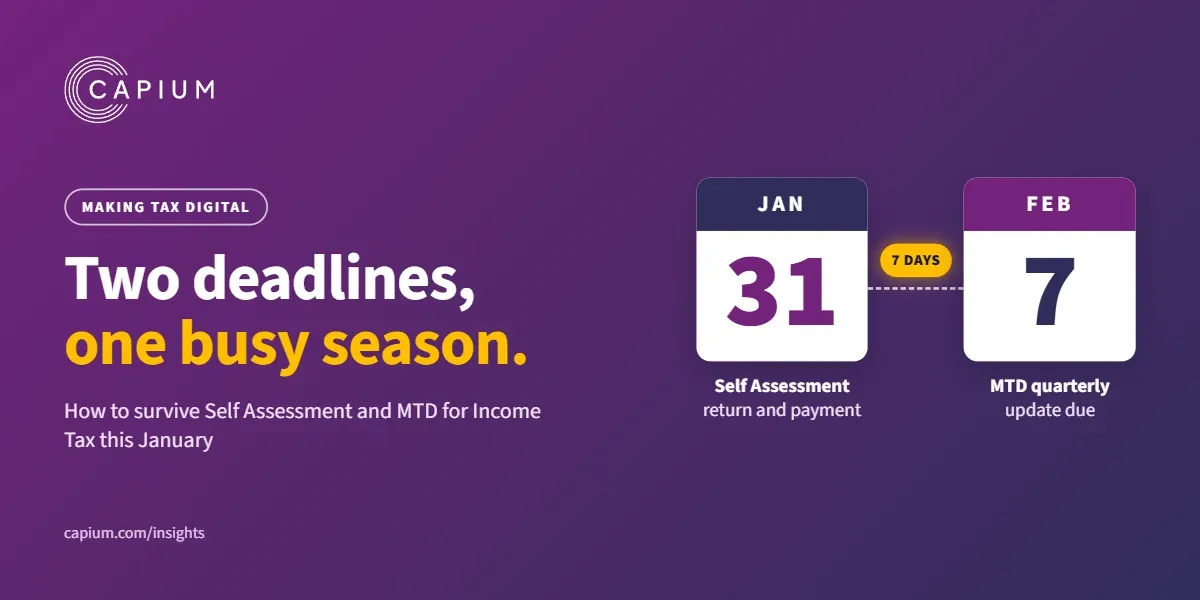
This year there is a sting in the tail. The 2025/26 Self Assessment deadline lands on 31 January 2027[1], and the next MTD for Income Tax quarterly update is due just seven days later, on 7 February.[2] For the first time, practices face two Self Assessment and MTD deadlines in the same busy season, often for the same clients.
Here is what has changed, what the MTD soft landing really covers, and a practical plan to get your team through January and February intact.
Why this January is different
MTD for Income Tax went live in April 2026 for sole traders and landlords with qualifying income over £50,000.[3] HMRC’s own figures show how much of that work landed on practices. Of the 864,000 taxpayers mandated, more than 570,000 had signed up and around 436,000 filed their first quarterly update on time.[3] More than two-thirds of sign-ups were made by an agent.
That means your MTD clients are very likely to be your Self Assessment clients too. The key dates now sit almost on top of each other:
| Date | Deadline | Who it affects |
|---|---|---|
| 31 January 2027 | 2025/26 Self Assessment return and balancing payment | All Self Assessment clients |
| 7 February 2027 | MTD quarterly update for the period to 5 January | Sole traders and landlords over £50,000 |
| 6 April 2027 | MTD for Income Tax extends to qualifying income over £30,000 | The next cohort |
The workload is not just two filings. It is two rounds of chasing records, two sets of client questions and one team trying to do both in the same six weeks.
What the MTD soft landing does and doesn’t cover
It is tempting to push 7 February to the bottom of the pile. For 2026/27, HMRC will not issue penalty points for late quarterly updates.[3] But the soft landing is narrower than many clients think:
- The updates are still required. Digital records must be kept, and all quarterly updates must be submitted before the client can file their MTD tax return.[4]
- It only covers 2026/27. From 2027/28, a missed quarterly update or tax return deadline can generate a penalty point.[4]
- Other penalties still apply. Late tax returns and late payments are not covered by the easement.[3]
Treat this year as a rehearsal. Practices that let February slide now risk building client habits that become expensive from April 2027.
The hidden third job: the April 2027 cohort
The Autumn Budget confirmed that the next wave of MTD for Income Tax goes ahead. Sole traders and landlords with more than £30,000 of qualifying income in 2025/26 come into scope from 6 April 2027.[5]
That makes this January’s returns more than a compliance exercise. The 2025/26 figures you file now are the ones that decide who joins MTD next. Every return is a chance to spot, price and prepare the next cohort while the numbers are in front of you.
The Budget also confirmed some breathing space for that group: clients joining in April 2027 will not receive late filing penalties for their 2027/28 quarterly updates.[6] Your existing over-£50,000 clients get no such extension, so plan for two different rulebooks from April.
A practical plan for November to February
- Triage now, not in January. Sort clients by risk and readiness: who has digital records, who is late every year, and who is MTD-ready.
- Pull Self-Assessment forward. Aim to complete as many 2025/26 returns as possible by mid-December, with firm internal deadlines for client records.
- Chase MTD records before 5 January. Ask for quarterly records at the same time as Self-Assessment paperwork, so 7 February is a batch job, not a scramble.
- Send one clear MTD email in November. Tell every MTD client what you need, by when, and why the soft landing doesn’t mean they can skip updates.
- Flag the £30,000 cohort as you go. Tag clients whose 2025/26 figures put them in scope, and book onboarding conversations for February and March.
- Check your pricing. Quarterly work is extra work. Make sure your engagement letters and fees reflect it before the new cohort arrives.
- Protect your team. Two peaks in six weeks is a burnout risk. Plan rotas and overtime now.
One workflow for Self Assessment and MTD
The practices coping best with both deadlines aren’t working longer hours. They are running Self Assessment and MTD for Income Tax in one workflow, so client data is entered once and every deadline sits in one view.
That is what Capium is built for. Bookkeeping, MTD for Income Tax, Self Assessment, accounts production, payroll and practice management share the same client data in one cloud platform. Less re-keying, fewer missed records, and a clear picture of who still owes you what before 31 January and 7 February.
Join the free webinar. Survive the January crunch: Self Assessment and MTD in one busy season is a live, 60-minute session with AccountingWEB’s Richard Hattersley, Capium co-founder Tushir Patel, Aaron Patrick and Emma Rawson. Wednesday 18 November, 12:00 (UK time). Can’t make it live? Register and we’ll send you the recording and a January planning checklist.
Get set up before the busy season. New to Capium? Buy the Capium Full Suite for 12 months this Black Friday and get 6 months free. That’s 18 months for the price of 12. Offer ends 30 November.
New customers only. 12-month Full Suite subscription purchased before 30 November. Terms and conditions apply.
Frequently asked questions
When are the Self Assessment and MTD deadlines this January and February?
The 2025/26 Self Assessment return and balancing payment are due on 31 January 2027, and the MTD for Income Tax quarterly update for the period to 5 January is due on 7 February 2027.
Does the MTD soft landing mean clients can skip quarterly updates?
No. For 2026/27 HMRC will not issue penalty points for late quarterly updates, but digital records must still be kept and all quarterly updates must be submitted before the client can file their MTD tax return.
Which penalties still apply during the MTD soft landing?
Late tax returns and late payments are not covered by the easement, and from 2027/28 a missed quarterly update or tax return deadline can generate a penalty point.
Who joins MTD for Income Tax in April 2027?
Sole traders and landlords with more than £30,000 of qualifying income in 2025/26 come into scope from 6 April 2027, so the 2025/26 returns filed this January decide who joins next.
How can a practice prepare for both deadlines?
Triage clients by risk and readiness now, complete as many 2025/26 returns as possible by mid-December, chase MTD records before 5 January, flag the £30,000 cohort, check pricing and plan staff rotas.
Further reading
- Follow the rules for Making Tax Digital for Income Tax GOV.UK
Sets out the digital record-keeping and quarterly update obligations landlords must follow once they are within MTD for Income Tax.
- Deadline approaches for first Making Tax Digital quarterly update GOV.UK
HMRC news update confirming the first quarterly update deadline and rollout details for affected sole traders and landlords.
- Making Tax Digital for Income Tax – an agents' guide on how to get ready Association of Taxation Technicians (ATT)
Practical guidance for agents and accountants preparing clients for MTD for Income Tax.
- Penalties for Making Tax Digital for Income Tax GOV.UK
Sets out how penalty points work for missed quarterly updates and tax returns, including the 2026 to 2027 easement.
- Find out if and when you need to use Making Tax Digital for Income Tax GOV.UK
Confirms the qualifying income thresholds and start dates, including the £30,000 cohort from 6 April 2027.
References
- Self Assessment tax returns, GOV.UK. Accessed .
- Use Making Tax Digital for Income Tax - Send quarterly updates - Guidance, GOV.UK. Accessed .
- 436,000 sole traders and landlords make their tax digital, GOV.UK. Accessed .
- Penalties for Making Tax Digital for Income Tax, GOV.UK. Accessed .
- Find out if and when you need to use Making Tax Digital for Income Tax, GOV.UK. Accessed .
- Budget: MTD penalty soft landing and exclusions, ICAEW. Accessed .