- Companies House
- Identity verification
- Confirmation statements
- ACSP
Companies House ID verification: the transition is over, now what?
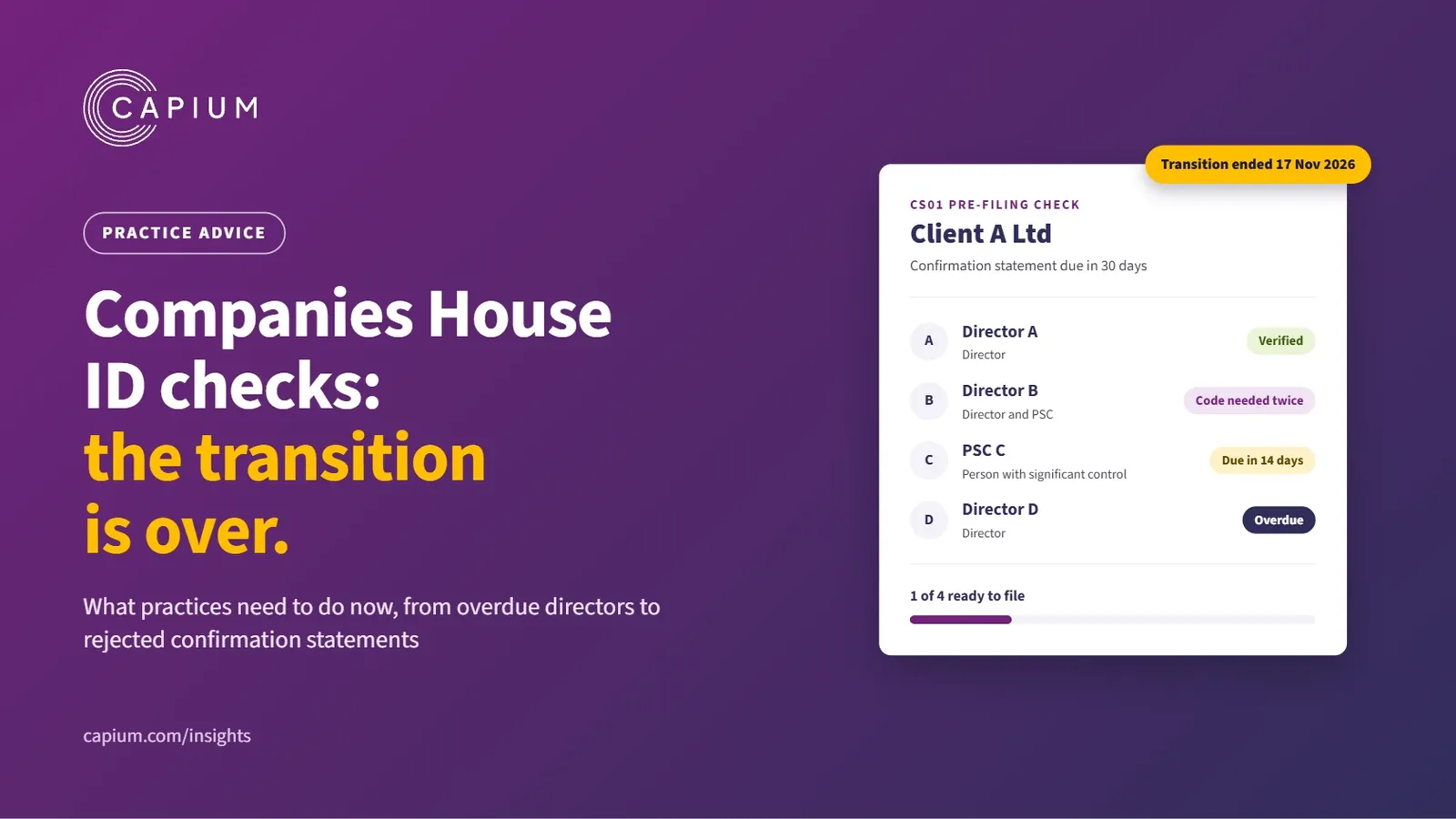
The 12-month transition for Companies House identity verification ended on 17 November 2026. Every existing director should now have verified their identity, with their personal code supplied on the company's confirmation statement.

7 min read
Key takeaways
- Transition ended:
- The 12-month transition for Companies House identity verification ended on 17 November 2026.
- Where things stand:
- As at 11 November 2026, 88.1% of companies had met the identity verification requirements linked to their confirmation statement and 11.4% were on a compliance or enforcement pathway.
- Enforcement:
- Companies House starts enforcement with reminders and a chance to make representations, and continued non-compliance can lead to financial penalties, prosecution and director disqualification.
- Verify once:
- A director with several directorships only needs to verify their identity once and uses the same personal code for each company.
- Why are filings rejected?
- Confirmation statements are held up by incorrect personal codes, a date of birth that does not match the register, or a director without a verified identity.
- Directors who are PSCs:
- Directors who are also PSCs verify once but give their personal code twice, once on the confirmation statement and once through the separate PSC service.
- ACSP registration:
- Practices that carry out identity verification for clients must be registered as ACSPs, while practices that only file documents do not yet have to register for that reason.
- Start earlier:
- Ask clients for personal codes a month before the confirmation statement is due, because directors who still need to verify will need time.
Most have. But for practices, the work hasn’t finished. It’s changed. The job now is following up with the clients who missed their deadline, and making ID checks a routine part of every confirmation statement you file.
Here’s where things stand, why filings are still being rejected, and a checklist to keep your clients on track.
Where things stand
Companies House published its one-year figures on 18 November 2026. As at 11 November:
- 88.1% of companies had met the identity verification requirements linked to their confirmation statement[1]
- 11.4% of companies were on a compliance or enforcement pathway[1]
- 12.18 million appointments had been verified
Companies House expects every company to have either met the requirements or be on a pathway to compliance or enforcement by the end of March 2027.
Enforcement has already started. It begins with reminders and a chance to make representations.[1] Where people still don’t comply, Companies House has used financial penalties and prosecutions, and the Insolvency Service has secured fines and director disqualifications. Companies House also plans to add notes to the public register where verification hasn’t been completed on time.
If around one in ten companies is still outstanding, most practices will have at least a few clients in that group.
The rules now
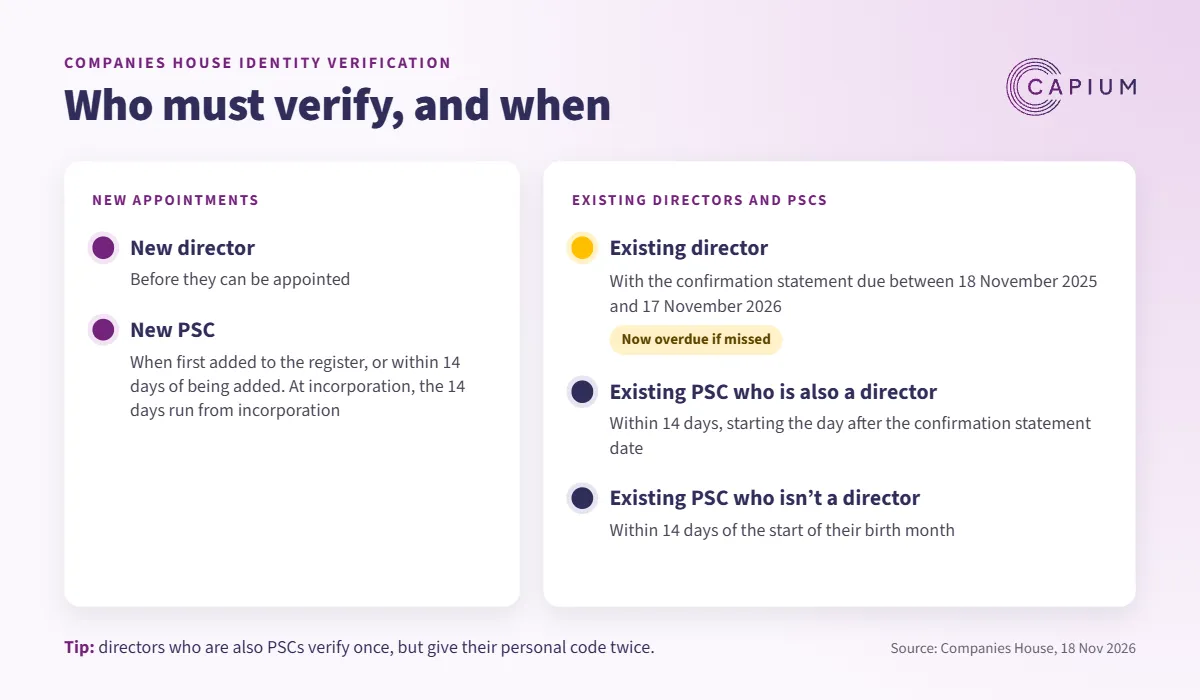
| Who | When they must verify |
|---|---|
| New director | Before they can be appointed |
| New PSC | When first added to the Companies House register, or within 14 days of being added. For PSCs at incorporation, the 14-day period runs from incorporation |
| Existing director | With the confirmation statement due between 18 November 2025 and 17 November 2026 |
| Existing PSC who is also a director | Within 14 days, starting the day after the company’s confirmation statement date |
| Existing PSC who isn’t a director | Within 14 days of the start of their birth month |
Existing directors should have completed identity verification in time for their company’s confirmation statement during the transition period.[1] If the company failed to file its confirmation statement during that period, the verification statement must be provided with its next confirmation statement. Directors who continue acting without completing the required verification may be committing an offence.
For PSCs who are also directors, the 14-day period starts the day after the company’s confirmation statement date. Filing the confirmation statement early doesn’t bring the PSC deadline forward.
Verification only happens once. A director with several directorships only needs to verify their identity once, and uses the same personal code for each company.
Why confirmation statements still get rejected
The verification itself is quick. The filing is where things go wrong. The most common problems are:
- Incorrect personal codes. An incorrectly entered personal code can prevent the confirmation statement from being accepted. Check every director’s code carefully before submitting the filing, even where the director believes their verification details have already been provided.
- A date of birth mismatch. You can’t file if a director’s date of birth doesn’t match the details on the register.[2]
- Directors who are also PSCs. They only verify once, but their personal code has to be given twice: once as a director on the confirmation statement, and once as a PSC through the separate PSC service.[2]
- Missing codes for some directors. One unverified director holds up the whole filing.
Each of these costs time close to the filing date. The fix is to check them earlier.
A checklist for practices
- Build a master list. For every client company, record each director, PSC and LLP member, the confirmation statement date, their verification status and whether you hold their personal code.
- Follow up with clients who missed their deadline. Start with directors whose confirmation statement fell due during the transition year and who haven’t verified. Then check PSCs against their 14-day windows.
- Add ID checks to your CS01 preparation. Before each confirmation statement, check that every director has a valid code, that dates of birth match the register, and that director-PSCs have also been verified as PSCs.
- Begin the process earlier. Ask for codes a month before the confirmation statement is due, not the week it’s due. Directors who still need to verify will need time.
- Store personal codes securely. Treat them as personal data. Keep them in your practice system with access controls, not in email threads or shared spreadsheets.
- Be clear on ACSP registration. There’s an important distinction between identity verification and filing:
- Practices carrying out identity verification on behalf of clients must be registered as ACSPs.[3]
- Practices that only file documents for clients don’t yet have to register solely for that reason.
- The new presenter identity verification and third-party filing restrictions won’t be introduced before November 2027.
- Companies House will provide at least six months’ notice.
- Explain the consequences of non-compliance to clients. Penalties, prosecution, disqualification and a public note on the register are a stronger prompt than a reminder email.
- Reflect the additional work in your fees. ID checks are now a recurring part of company secretarial work. Make sure your engagement letters and fees cover it.
What’s next
Two more Companies House changes will affect practices that file for clients:
- Presenter ID and ACSP registration for filing agents. Anyone filing documents will need to be identity verified, and third-party agents will only be able to file if they’re registered as an ACSP. This has been pushed back to no earlier than November 2027, and Companies House has said it will give at least six months’ notice.
- Accounts reform. From 1 April 2028, all companies will be required to file their annual accounts using commercial software, and Companies House’s paper and web-based accounts filing services will close.[4]
Neither needs action today, but both are worth building into your 2027 planning.
Keep every client’s filings on track
Capium brings accounts production, company secretarial work and practice management together in one connected cloud suite, so your team can see every client’s deadlines and filings in one place.
This article is general information, not legal advice. Companies House guidance may change; check GOV.UK for the latest position.
Frequently asked questions
When did the Companies House ID verification transition period end?
On 17 November 2026. Existing directors had to verify with their company's confirmation statement due during the 12 months from 18 November 2025.
What happens if a director hasn't verified?
Companies House starts with reminders and a chance to make representations. Continued non-compliance can lead to financial penalties, prosecution and director disqualification, and Companies House plans to add notes to the public register.
Why was my client's confirmation statement rejected?
The most common reasons are an incorrectly entered personal code, a date of birth that doesn't match the register, or a director without a verified identity. Check every code carefully before you submit.
Do accountants need to register as an ACSP?
Practices that carry out identity verification for clients must register now. Practices that only file documents don't yet have to register solely for that reason. Presenter verification and third-party filing restrictions won't come in before November 2027, with at least six months' notice.
Does a director with several directorships need to verify more than once?
No. Verification only happens once. The director uses the same personal code for every company they're involved with.
Further reading
- Identity verification is making the UK's company register more trustworthy Companies House (GOV.UK)
Companies House's one-year figures on identity verification compliance and its approach to enforcement.
- Being an Authorised Corporate Service Provider (ACSP) GOV.UK
Official guidance on which agents need to register as an ACSP now and which will need to later.
- Using a third-party provider to verify your identity with Companies House Companies House (blog)
Recent guidance (December 2025) on how ACSPs carry out identity verification on behalf of clients.
- Third-party providers: get ready to register as an Authorised Corporate Service Provider Companies House (blog)
Companies House's own update on the ACSP registration service going live, published March 2025.
- Companies House changes ACCA
ACCA guidance for practices on personal codes, date of birth checks and PSC verification when filing confirmation statements.
- Companies House update to accounts filing from April 2028 Companies House (GOV.UK)
The official update on software-only accounts filing and the closure of web and paper accounts filing.
References
- Identity verification is making the UK's company register more trustworthy, GOV.UK. Accessed .
- Companies House changes | ACCA Global, ACCA. Accessed .
- Being an Authorised Corporate Service Provider (ACSP), GOV.UK. Accessed .
- Companies House update to accounts filing from April 2028, GOV.UK. Accessed .