
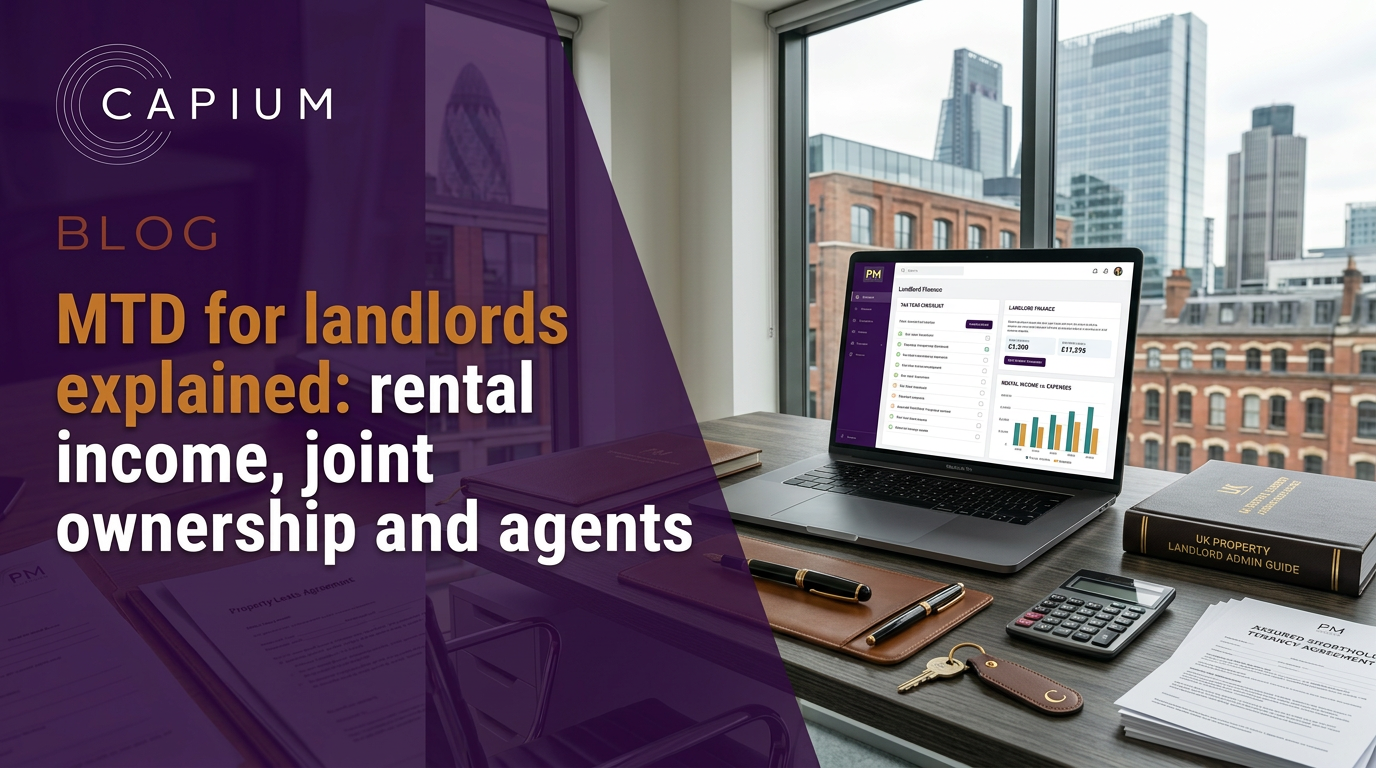
MTD for landlords explained: rental income, joint ownership and agents
Making Tax Digital (MTD) is steadily reshaping the UK tax system, and landlords are firmly in scope. If you receive property income, earn rental income from one or more properties, or share ownership with someone else, it’s important to understand how MTD for landlords works in practice.
From digital record keeping and quarterly updates to joint ownership rules and working with letting agents, there are a few areas where property owners commonly need clarity. Here’s what landlords need to know to stay compliant without unnecessary complexity.
How MTD for landlords applies to rental income
MTD for income tax applies to landlords based on qualifying income, which includes gross rental income from UK property income and foreign property income.
Making Tax Digital for Income Tax requires landlords and sole traders with income over £50,000 to use HMRC-approved software for digital record-keeping and quarterly reporting from 6 April 2026.
Crucially, this is based on gross income, not profit. That means rental income before expenses such as letting agent fees, maintenance costs, or mortgage interest. If your gross property income exceeds the relevant threshold, MTD applies – even if your taxable income is much lower once expenses are deducted. The thresholds for MTD are: April 2026 at £50,000, April 2027 at £30,000, and April 2028 at £20,000.
Employment income taxed through PAYE and bank interest do not count towards qualifying income, although they are still included later in the final declaration.
From 6 April 2026, landlords must use Making Tax Digital for Income Tax software if their total annual income from self-employment and property is over £50,000. The income threshold for MTD lowers to £30,000 in April 2027.
Digital record keeping for property owners
Under Making Tax Digital, landlords must maintain digital records for tax purposes. This means keeping correct digital records of rental income and expenses throughout the tax year, rather than relying on paper records or reconstructing figures for an annual tax return.
Landlords need to record income digitally, maintain business records in a compatible MTD software solution, and store financial records electronically. Expenses such as agent fees, maintenance costs, and other allowable costs should also be recorded digitally as they arise.
Residential property finance costs, including mortgage interest, continue to be treated under existing income tax rules and are reflected through the final declaration rather than quarterly updates.
Quarterly updates and tax reporting
Landlords within scope of MTD for income tax must submit quarterly updates to HMRC using compatible software.
These quarterly updates summarise rental income and expenses for each period. They are not tax returns, they do not calculate a tax bill, and they do not replace annual tax returns entirely.
Instead, quarterly reporting feeds into the end-of-year position. After the tax year ends, landlords submit a final declaration, which replaces the traditional self assessment tax return and confirms taxable income, adjustments, and reliefs.
This shift in tax reporting is often one of the biggest adjustments for landlords used to annual income tax self assessment.
Joint ownership and property income under MTD
Joint ownership is one of the most important areas to get right under MTD.
Where a property is jointly owned, each joint owner must report their share of the rental income separately. Making Tax Digital does not change how income is split – it is still based on beneficial ownership, not who receives the rent into their bank account. The concept of beneficial joint tenants is important here, as it determines the legal and beneficial rights and responsibilities of each owner within the tenancy agreement.
This applies whether the property is owned as joint tenants or tenants in common. If property is held as joint tenants, both owners have equal rights to the property and it passes automatically to the surviving owner upon death. If property is held as tenants in common, each owner can have different shares and their share can be passed on to heirs upon death. Each owner must maintain digital records for their portion of the property income and submit quarterly updates if their qualifying income exceeds the threshold. To determine the type of joint ownership, individuals can check their title register or consult their conveyancer.
If circumstances change – for example, one owner sells their share, ownership changes at HM Land Registry, or one owner dies – reporting responsibilities may also change and records should be updated accordingly. If the joint owner breaks, such as in the event of a breakup or sale, reporting responsibilities may change, and it is recommended to consult a legal adviser and a financial adviser before making any changes.
Using letting agents and managing digital records
Many landlords use letting agents to manage rental properties, collect rent, and handle day-to-day administration. This does not change under Making Tax Digital.
However, responsibility for tax affairs remains with the landlord. Letting agents may provide rental statements and expense breakdowns, but landlords are still responsible for maintaining digital records, submitting quarterly updates, and completing the final declaration.
Some landlords use property management software alongside MTD compatible software to ensure rental income and expenses are captured digitally and transferred accurately. Others rely on accountants or tax agents using an integrated MTD hub to manage submissions on their behalf using compatible software and an agent services account.
Choosing compatible software as a landlord
MTD requires landlords to use compatible software that can maintain digital records and submit quarterly updates to HMRC.
Some landlords continue to use spreadsheets with bridging software, provided digital links are maintained and records remain compliant. Others prefer MTD-compatible accounting software that combines digital record keeping, quarterly reporting, and final declarations in one system.
The right approach depends on the complexity of your rental business – whether you own more than one property, have jointly owned property, or also receive self employment income and need a simple MTD platform for small landlords.
What matters is that the software is MTD compatible and supports accurate digital records, correct reporting, and compliance with tax digital requirements, ideally alongside wider compliance and risk management tools.
What doesn’t change for landlords
Despite the move to tax digital for income, much remains familiar.
Income tax rules themselves do not change. Capital expenditure and capital gains are treated as they always have been. Corporation tax only applies where properties are held within a company, while MTD for VAT software remains relevant primarily for VAT-registered property businesses. The tax year structure remains the same, and tax is still paid in line with existing deadlines.
Making Tax Digital changes how information is submitted, not the fundamentals of how rental income is taxed.
Preparing for MTD as a landlord
Even if MTD for landlords does not apply to you immediately, preparing early can make a significant difference. Maintaining digital records, understanding how joint ownership affects tax reporting, and reviewing how agent-provided data feeds into your tax affairs all help reduce risk, especially when combined with strong compliance tools and resources. The aim is to adapt gradually, not to overhaul everything at once.
Supporting landlords with Making Tax Digital
Capium’s MTD compatible software supports landlords with digital record keeping, quarterly reporting, and final declarations. Whether you receive rental income from one property or manage a more complex rental business, Capium helps property owners meet tax digital requirements with clarity and confidence.