
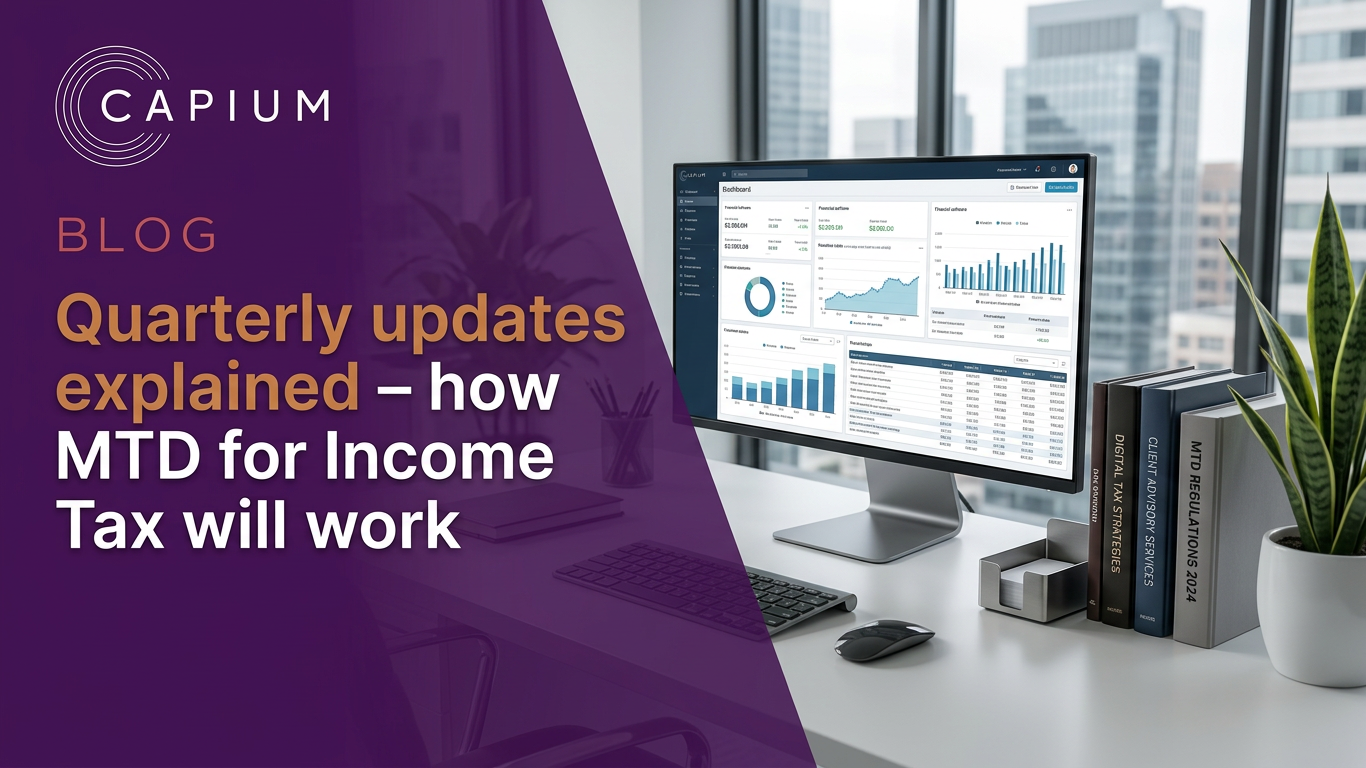
Quarterly updates explained – how MTD for Income Tax will work
When people talk about Making Tax Digital for Income Tax Self Assessment (MTD for Income Tax), they usually focus on the headline change – moving from one annual tax return to multiple submissions each year. In practice, it’s these quarterly updates that will reshape how income tax works for self-employed individuals and property landlords.
Eligibility for MTD is based on gross qualifying income, which includes self-employment turnover and gross rental income from self employment and property. Qualifying income excludes employment income, pensions, dividends, and savings interest. Property landlords and self-employed individuals with gross income (annual turnover) over the turnover threshold of £20,000 will be required to comply with Making Tax Digital for Income Tax, while those with turnover of £20,000 or less will remain in the current Self-Assessment regime. Individuals who do not have a national insurance number on 31 January or those receiving the blind persons allowance are exempt from MTD for the following tax year. Making Tax Digital for Income Tax will not change the due dates for paying income tax or filing the tax return.
Quarterly updates aren’t tax returns. They don’t calculate a tax bill or trigger a payment. But they do introduce a new rhythm to income tax reporting – one that’s far more regular, far more digital, and far more dependent on software.
Here’s how they actually work.
What quarterly updates are – and what they aren’t
Under MTD for Income Tax, individuals with qualifying income from self-employment or property above the threshold will need to send four quarterly updates to HMRC for each tax year.
Each update is submitted as a digital tax return and is a summary of income and expenses for a specific period. These updates must include totals of income and expenses (total income) for the period. It’s not a full tax return, and it doesn’t include end-of-year adjustments such as capital allowances, loss relief, pension contributions or personal allowances.
Think of quarterly updates as progress reports, not final answers.
They give HMRC a rolling view of business and property income, while allowing taxpayers and accountants to see an evolving income tax position throughout the year. Quarterly updates are summaries of financial data submitted every three months to HMRC, and if no income or expenses occurred during a quarter, a nil return must be submitted.
Quarterly updates do not include tax reliefs or adjustments, which are only consolidated in the final declaration.
The quarterly periods and deadlines
The quarterly obligation to submit updates applies to all businesses and landlords required to comply with MTD for Income Tax, regardless of when their accounting period ends. MTD for Income Tax uses fixed calendar quarters for quarterly submissions:
- 6 April – 5 July
- 6 July – 5 October
- 6 October – 5 January
- 6 January – 5 April
Quarterly submissions are required for these standard quarters, irrespective of a business’s accounting period.
Each quarterly update must be submitted digitally using MTD-compatible software, with the following deadlines:
- 7 August
- 7 November
- 7 February
- 7 May
The first relevant tax year for MTD is 2026–27, with the first quarterly updates due on 7 August 2026 and the first final declaration due on 31 January 2028. The final quarterly update is the last submission before the year-end final declaration, which also requires the completion of an End-of-Period Statement.
The first quarterly updates under MTD will be due on 7 August 2026, covering the period from 6 April to 5 July 2026. Missed submissions will count towards HMRC’s penalty points system, rather than triggering immediate fines.
Cumulative reporting – corrections are expected
One of the most important (and often misunderstood) aspects of quarterly updates is that they are cumulative.
Each submission includes totals from the start of the tax year up to the end of that quarter. If an error is discovered in a previous submission – such as a missed expense, duplicated income, or incorrect categorisation – it can be corrected in the next quarterly update. This cumulative approach allows corrections for previous submissions, ensuring accuracy and compliance throughout the year.
This is deliberate. HMRC expects figures to change over time as records are refined and bank transactions are reconciled. Accuracy still matters, but quarterly updates are designed to reflect real-world bookkeeping, not perfection on day one.
Quarterly updates are a simple summary of transactions and do not require tax adjustments; these are only made in the final declaration, which finalises the tax position for the year.
Separate updates for each income source
Quarterly updates are submitted per trade or property business, not per taxpayer. Separate quarterly updates are required for each trade or property business, including for multiple properties.
That means:
- A sole trader with one business submits one set of quarterly updates
- A landlord with UK property income submits a separate set
- Someone with both self-employment and rental income submits two quarterly updates each quarter.
Joint property owners must each assess their own qualifying income to determine if they fall within the scope of MTD, and may be required to submit separate quarterly updates, even for jointly owned or multiple properties.
Overseas property income is treated separately again. This is why software matters – managing multiple income streams manually quickly becomes unworkable.
Digital records are non-negotiable
Quarterly updates are built on digital record keeping.
Taxpayers must keep digital records of income and expenses and submit updates using commercial accounting software or bridging software that connects directly to HMRC via API. Paper records alone won’t meet the requirement, even if figures are later typed up.
The government has given an undertaking that free software will be made available for taxpayers with the most straightforward financial data, but HMRC does not provide free software itself and instead offers a list of approved providers.
Most MTD-ready systems support:
- Bank feeds to capture income automatically
- Digital links between records and submissions
- Categorisation of expenses in line with tax rules
- A clear audit trail for each quarterly update.
For accountants, this is what turns quarterly reporting from an administrative burden into something manageable.
Quarterly updates don’t replace the final declaration
Quarterly updates are only part of the MTD process.
At the end of the tax year, taxpayers will still need to submit a final declaration. This replaces the traditional Self Assessment tax return and is where:
- Accounting adjustments are made
- Reliefs and allowances are applied
- Other income is declared – such as employment income or bank interest
- The final income tax and National Insurance position is confirmed
- The final declaration triggers HMRC’s real-time final tax calculation, determining the taxpayer’s tax liability for the year, including any balancing payments, penalties, or interest charges.
Tax reliefs are only included in the final declaration, not in quarterly updates.
In other words, quarterly updates feed the system – the final declaration completes it.
Why this matters for accountants and clients
Quarterly updates introduce a significant behavioural shift. Clients can no longer leave record keeping until January. Accountants can’t rely on once-a-year data clean-ups. Managing tax affairs digitally is crucial under MTD, as a points-based penalty regime will apply, with penalty points issued for late submissions. The new system rewards:
- Regular bookkeeping
- Early visibility of income tax liabilities
- Proactive conversations about cash flow and tax planning.
Done well, quarterly updates reduce surprises and spread the workload across the year. Done badly, they create stress, missed deadlines and avoidable penalties. Under the new regime, a £200 fine will be issued once a reporting threshold is reached, typically four penalty points for quarterly reporters. A ‘soft landing’ will apply for the first year (2026/27), with no penalty points for late submissions for the first mandated group.
The role of software in making quarterly updates work
Without the right accounting software, quarterly updates will feel like extra work layered on top of existing processes.
MTD-compatible software should make it easier to:
- Maintain digital records throughout the year
- Submit quarterly updates directly to HMRC
- Track deadlines and submission status
- Handle multiple income sources cleanly
- Support clients who aren’t digitally confident.
This is where platforms like Capium come into their own – combining bookkeeping, tax reporting and MTD-ready submissions in one place, with visibility for both accountants and clients.
Turning quarterly updates into something manageable
Quarterly updates aren’t going away – but they don’t have to be painful. With the right systems, clear client education and software built for MTD from the ground up, accountants can turn quarterly reporting into a predictable, low-friction process rather than a quarterly fire drill.
Capium’s MTD software is designed to support quarterly updates, digital record keeping and final declarations – helping firms stay compliant while keeping workloads under control. If you’re preparing clients for MTD for Income Tax, now’s the time to see how Capium can support your quarterly reporting workflow.