
AML 2026: What Payroll and Accountancy Firms Need to Know Before November
AML compliance is becoming an increasingly important consideration for accountancy and payroll firms. With further regulatory changes expected later this year, now is the time to review your processes and make sure your firm is prepared.
For many accountancy firms, anti-money laundering compliance has long been part of the day-to-day responsibilities of running a practice. Client due diligence, identity checks, risk assessments, ongoing monitoring and record keeping are all familiar requirements.
But the AML landscape continues to evolve.
As regulatory expectations develop and more businesses come within scope of AML requirements, firms need to think beyond simply completing individual checks. They need to consider whether their overall AML processes are consistent, proportionate and robust enough to support the way their practice operates today.
For payroll providers in particular, changes expected from November 2026 make this an important area to understand now.
Why AML should be on your agenda in 2026
AML compliance isn’t simply about responding to a regulatory requirement. Effective processes can help firms understand who their clients are, identify potential risks earlier and create a clearer audit trail around important decisions.
For growing practices, however, maintaining those processes can become increasingly difficult.
Client numbers increase. Teams grow. New services are introduced. Different people become responsible for different parts of the client journey.
Without clear processes, AML checks can become another source of manual administration.
A client may provide information during onboarding, only for the same information to be requested again later. Risk assessments may be completed differently by different members of the team. Records can end up spread across emails, spreadsheets and separate systems.
Individually, these may seem like small issues. Across hundreds of clients, they can create significant administrative overhead — and make it harder to demonstrate that your firm’s AML procedures are being followed consistently.
What’s changing for payroll providers?
One of the key areas firms need to understand is the anticipated AML changes affecting payroll providers from November 2026.
For businesses that may be affected, the important question isn’t simply “What are the new rules?”
It’s also:
“What do we need to change in our business to comply with them?”
That could mean reviewing existing client onboarding procedures, updating AML policies, assessing training requirements and considering how checks and records are managed across the practice.
The earlier firms understand what the changes mean for them, the more time they have to identify gaps and make changes without having to overhaul their processes at the last minute.
Does your AML process stand up to scrutiny?
A strong AML framework should extend well beyond an initial identity check.
Firms should consider the complete compliance journey, including:
- Business-wide risk assessment
Your firm’s risk assessment should reflect the nature of your business, your clients, the services you provide and the markets you operate in.
It’s not a document that should simply be completed once and forgotten. As your practice changes, your assessment may need to change with it.
- Client due diligence
Client onboarding is one of the most important points in the AML process.
Firms need appropriate procedures for establishing and verifying client identity, understanding the nature and purpose of the relationship and identifying any factors that could increase risk.
- Ongoing monitoring
AML doesn’t end once a client has been onboarded.
Firms need to consider how they will identify changes in circumstances or information that could alter a client’s risk profile.
The challenge is making ongoing monitoring practical when a practice is managing a large client base.
- Record keeping and audit trails
It’s important to be able to demonstrate what checks were carried out, when they were completed and what decisions were made as a result.
A clear digital audit trail can make this considerably easier than relying on disconnected records and manual processes.
- Training and accountability
Everyone involved in the relevant client processes needs to understand their responsibilities.
As firms grow, this becomes particularly important. New employees and team members need appropriate training, while managers need confidence that processes are being followed consistently.
The technology question
Technology can play an important role in making AML compliance easier to manage — but simply adding another piece of software isn’t necessarily the answer.
The bigger question is how AML fits into the wider workflow of the practice.
For example, if client information is collected during onboarding, can the relevant checks be completed as part of that process?
Can identity verification and screening be carried out digitally?
Can risk assessments be managed consistently?
Can the firm maintain a clear record of the checks that have been completed?
And can the people responsible for managing clients access the information they need without constantly switching between systems?
These questions become increasingly important as practices grow.
The aim should not be to create more technology for the sake of it. It’s about using technology to reduce repetitive administration while creating more consistent and transparent compliance processes.
Don’t wait until November to review your processes
Regulatory change can often feel like something that needs to be dealt with when the deadline arrives.
But AML is different.
If your firm’s processes need to change, you may need to review policies, update workflows, train staff and consider how technology can support the new requirements.
That takes time.
Starting the conversation now gives firms an opportunity to understand what’s changing and identify what, if anything, they need to do differently.
And even if your current AML processes are already robust, reviewing them can highlight opportunities to make them more efficient, more consistent and easier for your team to manage.
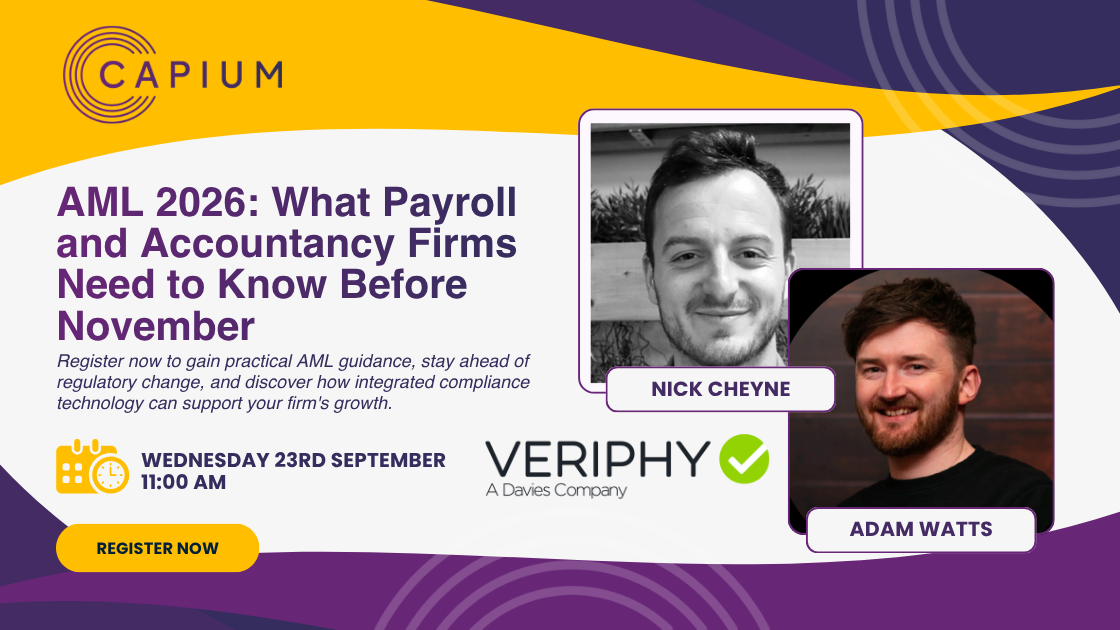
Join Capium and Veriphy: AML 2026 — What Payroll & Accountancy Firms Need to Do Before November
Want to understand what the upcoming changes could mean for your business — and what you should be doing now?
Join Capium and Veriphy on Wednesday 23 September at 11:00am BST for a practical one-hour webinar exploring the evolving AML landscape and the anticipated changes affecting payroll providers.
We’ll cover:
- What’s changing: The latest AML developments and what firms need to know
- November 2026: What the anticipated changes could mean for payroll providers
- Practical compliance: Risk assessments, KYC, client due diligence and ongoing monitoring
- Common challenges: Where firms can encounter gaps in their AML processes
- Technology: How digital tools can help streamline checks, improve consistency and reduce administration
- What’s next: Practical steps firms can take to prepare for continued regulatory change
You’ll also have the opportunity to put your questions directly to our AML experts during a live Q&A.
Don’t just understand the changes — understand what they mean for your practice.
Wednesday 23 September 2026 | 11:00am–12:00pm BST
This webinar is intended to provide general information and practical guidance. Firms should consider their own circumstances and obtain appropriate professional or regulatory advice where necessary.